


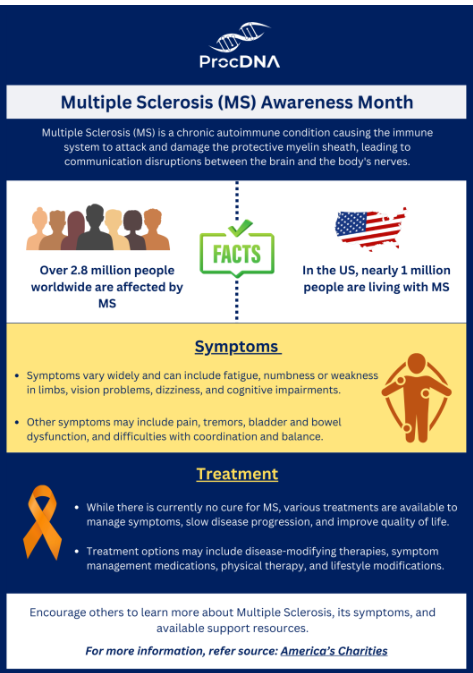
National MS Education and Awareness Month, established in 2003, occurs annually in March. Led by MS Focus: The Multiple Sclerosis Foundation and other affiliated groups, including the MS Association of America and the National MS Society, it aims to raise public awareness of Multiple Sclerosis (MS). This month includes Multiple Sclerosis Awareness Week, starting on the 10th. These campaigns have two key objectives: enhancing understanding of MS and empowering individuals with MS to make informed healthcare decisions.
MS affects the central nervous system, including the brain, spinal cord, and optic nerves. Its exact cause remains unknown, but it triggers an immune response that attacks the central nervous system, damaging the protective myelin around nerve fibers. This disruption impairs communication between the brain and other body parts, resulting in symptoms like numbness, tingling, mood changes, memory issues, pain, fatigue, blindness, and paralysis. While there is no cure for MS, medications can modify its course, manage symptoms, and treat relapses, creating a large unmet need for the pharmaceutical industry.
The demand for new medications has surged due to unmet medical needs. This demand is so great that in the beginning of the year a report from Evaluate predicted that, a phase 3 MS drug with a novel Mechanism of Action, evobrutinib, was potentially one of the most valuable pipeline drugs of 2024. However, since that report was released, evobrutinib fell short of expectations in clinical trials; terminating this programs development. Data presented at American Committee for Treatment and Research in Multiple Sclerosis (ACTRIMS®) earlier this month revealed that the drug was not more effective than other treatments but had more toxicity. These results were quickly made available on X (the platform formerly known as Twitter) by the investigator presenting them. AUXO platform from ProcDNA allows users to track Social Media posts from Key Opinion Leaders and their interaction with other KOLs in the MS space. AUXO can search KOLs by numerous factors including early, emerging and expert KOLs. Users can even create their own KOL archetypes including Digital Opinion Leaders (DOLs). Also, AUXO can show the research network relationships between such KOLs.
Last year the FDA approved the first disease-modifying biosimilar treatment for relapsing MS, Tyruko. AUXO platform could allow users to understand the competition between this biosimilar sold by Sandoz (Novartis) and the original reference medication, Tysabri (Biogen), in the KOL space, including differences in marketing strategy between these two products.
About AUXO and ProcDNA: AUXO platform allows users to identify Key Opinion Leaders (KOLs) and trends in KOLs. For more information about AUXO platform, please contact Contact.auxo@procdna.com
AUXO, was developed by ProcDNA, an analytics and tech consulting firm which serves life sciences clients and related verticals by accelerating commercial and clinical investments. Our expertise spans Commercial Planning and Analytics, Sales Strategy and Ops, Artificial Intelligence and Machine Learning, Data Partnerships, and Commercial Technology. Learn more about ProcDNA at procdna.com.
Read More Articles
Connect with us


Capabilities
©2026 ProcDNA Inc. | All Rights Reserved