

BACK TO ARTICLES
Do Segmentation and Demand Estimation really Need to be Separate? Looking beyond Efficiency to Unlock New Insight
Written by -Nishant Agarwal ,Savit Sharma,Aritra Das
,Savit Sharma,Aritra Das
Why even the Question?
For many brands and insights leaders, demand estimations are as sacred as segmentations given they are fundamental pieces of critical market research critical, often planned as 10-14 weeks projects independently.
With the pharma launch volume growing over the last few years, more emerging companies prepping for their first launches, the question has now been asked by pharma insights leaders, more number of times than I would like to admit.
Can we explore running demand estimation and segmentation research together?
The question itself often comes with hesitation, with often a preference to run them separately, but the question has merit nevertheless.
With extreme survey fatigue, especially in HCPs who treat rare diseases, combining these pieces of research go beyond just time or cost savings; there are in fact new insights to be uncovered.
When does a Combined Approach Work?
Combining segmentation and demand estimation into a single research effort can be highly practical under real-world constraints. It is particularly relevant when budgets are tight, timelines are compressed, or access to respondents (e.g., HCPs) is limited.
- Viable under budget, timeline, or sample constraints
- Enables a single-touchpoint data collection approach
- Reduces operational complexity compared to running two separate studies
What are the Key Trade-offs to Consider?
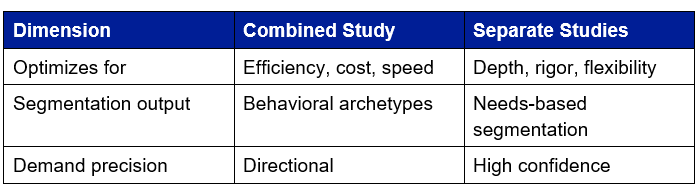
- Depth vs. Breadth:Standalone segmentation studies typically run 40–45 minutes with a need for long and rich attitudinal batteries. In combined studies, survey time is split, resulting in reduced depth and fewer hypotheses tested.
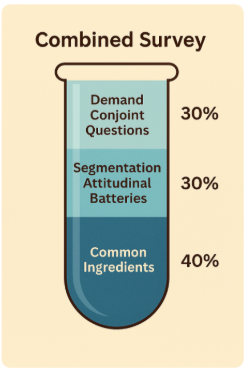
Do we even have the Space in the Survey?
It’s not surprising when you look under the hood of the 2 surveys, about 40% of the survey is often common with topics like the screener, how many patients of the relevant disorder they treat, and where they practice.
Segmentation attributes need to be often trimmed based on an informed discussion and conjoint design has to be more precise to not take away bulk of the real estate.
- Impact on Demand Estimation Quality:Robust demand estimation requires time for respondents to absorb product profiles and evaluate scenarios. In combined studies, reduced cognitive engagement may lead to lower precision in share estimates. This becomes even more critical when running complex conjoint exercises. We may need to consider what are the must have profiles vs good to have profiles to ensure the data collected is critical for the analysis and success.On the other hand, trimming the constructs or themes to be tested for segmentation related attributes that may be differentiating seems daunting. When the hypothesis workshop brings together the right stakeholders together and is setup as a conversational exercise and not just “vetting the stated hypothesis”, it can really trim down the questions to be asked in the survey, anchored to what the team finds actionable.
- Segmentation Philosophy Shift:Pure segmentation is typically rooted in attitudes, needs, and motivations. However, combined studies often shift toward behavior-driven archetypes reflecting expected prescribing behavior. The team has to come together to make sure the segmentation can stand on its own, allowing for attitudinal definitions that can be acted upon by the marketing team as well.
The Golden Insights Unlocked by Combining Demand Estimation and Segmentation
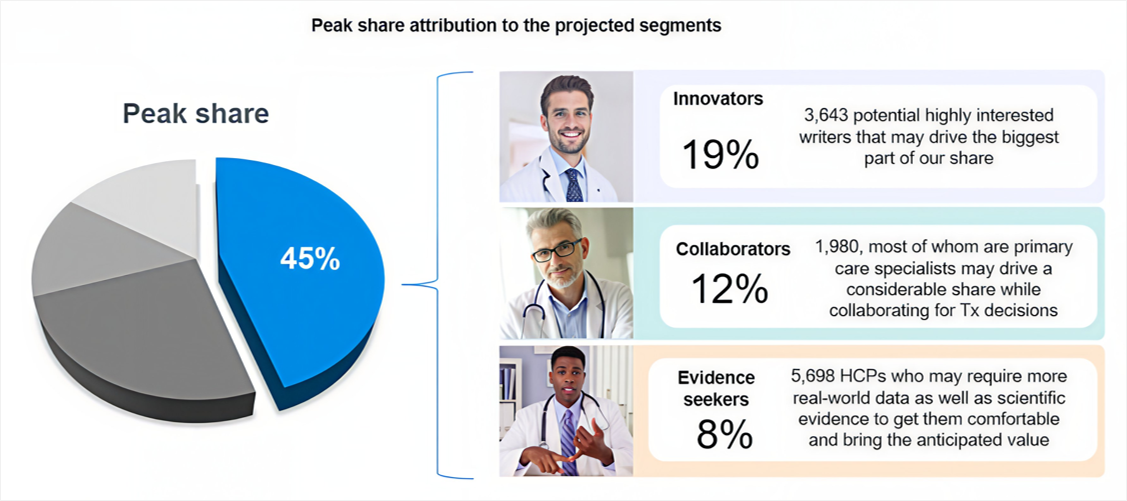
If done right, this can actually present an opportunity – running an attitudinal segmentation modelling exercise independent from the conjoint modelling and then finding our the “Source of Share” from the segments – Which segment contributes to x% of the anticipated peak share.
Once the segments are projected to a target list, this presents a real opportunity of acting upon the segments and bringing both pieces of insights to use and life.
The attribution of the peak share to the projected target list and help both sales and marketing team to super charge early wins and sustained growth.
How to Mitigate the Gaps?
A hybrid model can help balance trade-offs:
- Conduct a combined quantitative study for sizing and directional segmentation
- Modular survey design / smart routing
- Prioritized hypothesis-led segmentation
- Follow up with qualitative interviews (~6–8 per segment)
- Use qualitative insights to deepen understanding of drivers and enrich storytelling
Closing Thoughts
Combining segmentation and demand estimation is not really a compromise, it can be a strategic choice.
When done right, it shifts the role of market research from describing the market to actively shaping go-to-market decisions with an integrated lens.
The question is no longer can we combine them?
It’s whether we are clear enough on what we want to get out of it and bring the right stakeholders together to let the insights shine.
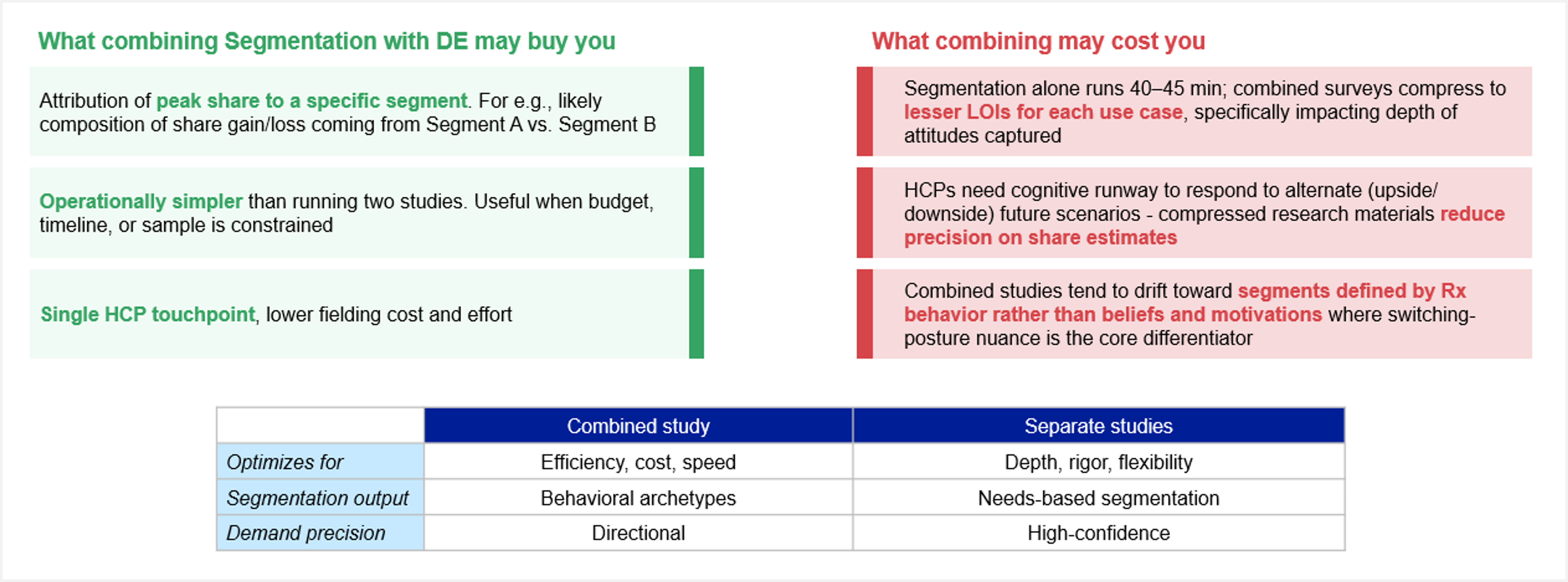
Here is a Quick Cheat Sheet if you are Wondering on this Question
Combining Segmention & DE With a measured approach, combining segmentation with a new demand study is feasible but there are clear trade-offs to be aware of
Read More Articles
Connect with us


Capabilities
©2026 ProcDNA Inc. | All Rights Reserved